

Capacitor Bank Switching
Capacitor bank switching studies assess severe transient overvoltages and high-frequency inrush/outrush currents generated during the energization, de-energization, and restrike of shunt capacitor banks. MEPCO models switching transients in PSCAD/EMTDC, sizes current-limiting damping reactors, and verifies that equipment ratings and customer voltage quality remain protected.
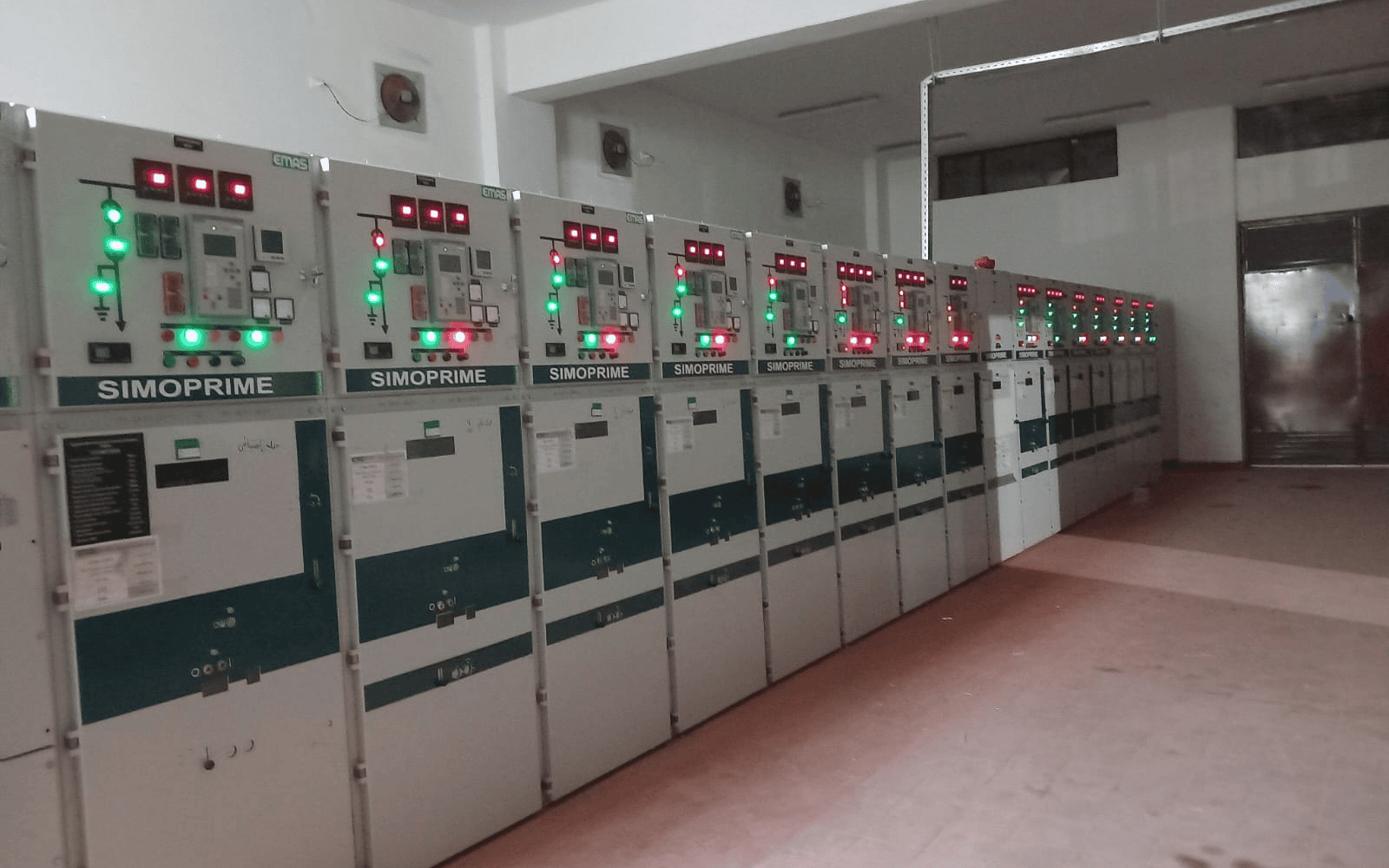
Figure 1: Capacitor bank switching cubicles and inrush current limiting reactors.
Technical Scope & Engineering Capabilities
MEPCO Engineering Projects brings specialized domain knowledge, rigorous modeling standards, and practical site experience to every assignment. Our scope covers:
- Isolated & Back-to-Back Switching Analysis: Calculating high-frequency inrush currents and peak transient overvoltages when energizing a capacitor bank adjacent to already-energized banks.
- Inrush Current Limiting Reactor Sizing: Sizing series damping reactors to limit peak inrush current (\(I_{peak}\)) and inrush frequency (\(f_i\)) within circuit breaker and switch ratings.
- Circuit Breaker Transient Stress: Evaluating Rate of Rise of Recovery Voltage (RRRV) and checking circuit breaker restrike-free performance.
- Outrush Current Calculation: Calculating outrush currents flowing into nearby close-in bus faults.
- Controlled Switching (Point-on-Wave): Evaluating point-on-wave (POW) synchronous closing controllers and pre-insertion resistors to mitigate switching transients.
Software Platforms & Computational Tools
Primary Tool: PSCAD / EMTDC (Electromagnetic Transient Simulation Engine).
Applicable Standards & Grid Codes
Standards: IEEE C37.99 (Guide for the Protection of Shunt Capacitor Banks), IEC 60871-1, IEEE C37.012.
Methodology & Project Delivery Workflow
Our engineering delivery aligns with MEPCO’s structured 6-stage project execution framework, ensuring quality throughout input verification, design modeling, and client handover:
- Stage 01 — Scope & Criteria Definition: Establish study boundaries, utility tie-in data, single-line diagrams, and client objectives.
- Stage 02 — Data Audit & Modeling Assumptions: Collect, verify, and validate manufacturer datasheets, impedance tolerances, and site operating configurations.
- Stage 03 — Simulation Model Development: Build detailed, validated mathematical digital models in specialized power software.
- Stage 04 — Computational Analysis & Verification: Execute base-case and contingency scenarios, conducting rigorous internal peer reviews.
- Stage 05 — Client Review & Approval: Present study findings, address technical comments, and participate in technical clarification sessions.
- Stage 06 — Final Handover: Deliver formal certified engineering reports, executive summaries, and native simulation model files.

Figure 2: Substation capacitor bank transient overvoltage modeling in PSCAD.
Completed Project References (From MEPCO Profile)
Selected project assignments delivered by MEPCO demonstrating our technical execution and regional client trust:
| Project Name | Client / Authority | Location | Tools / Mode | Scope Executed |
|---|---|---|---|---|
| Sabtank AC network, Hadeed 1 & 2 Plants | SABIC Company | Saudi Arabia | PSCAD | Capacitor Bank Switching Study, Back-to-Back Transient Inrush Analysis, and Inrush Reactor Sizing. |
| AR-RAZI Substation | Saudi Methanol Company | Saudi Arabia | PSCAD | Transient Switching and Overvoltage Mitigation Study. |
Key Engineering Deliverables & Outputs:
- Capacitor Bank Switching Analysis Engineering Report.
- Peak Inrush / Outrush Current and Voltage Waveform Plots.
- Inrush Damping Reactor Sizing Calculation Sheets.
- Circuit Breaker Transient Switching Duty Verification Sheets.
- Native PSCAD/EMTDC simulation cases.
Inquire About This Service
Contact MEPCO’s engineering team for technical proposals, study scope definition, or project consultations:
Email: m.khaled@mepco-tds.com | Phone: +20 11 2696 7082 | HQ: 5 Al-Ibrahimia Street, Cairo, Egypt